

What the Five-Spoke Life Integration Model Is — and What It Isn't
Most frameworks in the mental health and wellness space have the same problem: they are better at describing than locating. They give you a vocabulary for what is happening — sometimes a thorough one — but they often leave the question of where to actually intervene largely unanswered. The result is that people accumulate accurate self-descriptions without gaining much traction, which creates its own kind of frustration.
The Five-Spoke model is also not claiming to have discovered a new human truth. Its value is not novelty. It is better understood as a curated synthesis — a way of organizing principles that already exist across therapy, psychoeducation, coaching, and applied psychology into a more coherent structure. The pieces are not new. The integration is.
The Five-Spoke Life Integration Model was developed to address a different problem: not just naming patterns, but routing them. That means understanding where in a person's life system a given difficulty is actually originating and what it is costing the surrounding domains, so that effort goes to the right place rather than to the presenting symptom.
That is a specific purpose, and it is worth being clear about what it entails — and what it does not.
What It Is
The model organizes adult functioning into five interdependent domains — referred to as spokes — each of which places recurring demand on a person's capacity and each of which interacts with the others in predictable ways.
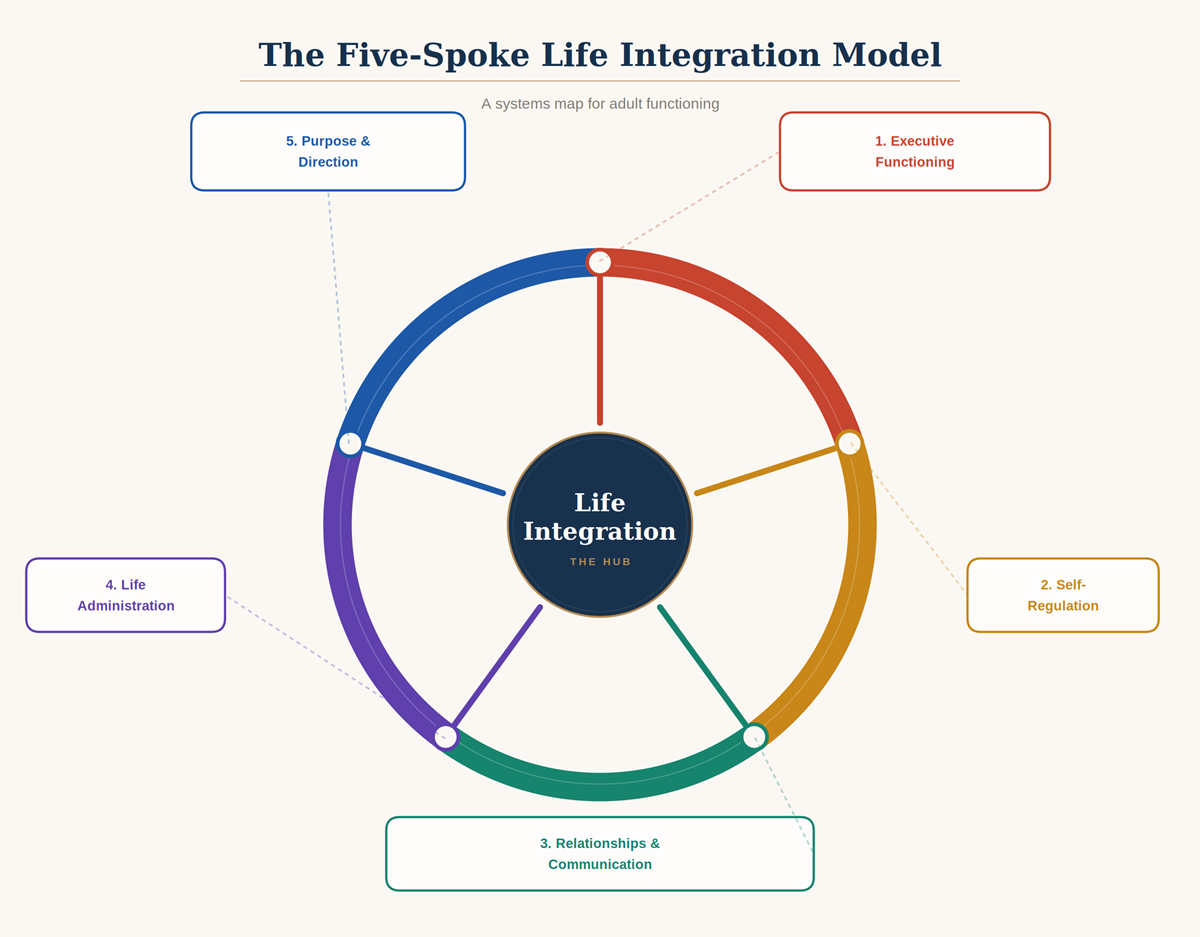
| Spoke | In plain language |
|---|---|
| Executive Functioning | Getting started and staying on track |
| Self-Regulation | Managing emotions, energy, and stress |
| Relationships & Communication | Feeling connected and understood |
| Life Administration | Keeping life running |
| Purpose & Direction | Knowing what matters and where you're headed |
-
Covers the cognitive processes involved in translating intention into action: task initiation, planning, sequencing, working memory, and follow-through. Not motivation, not discipline — the specific coordination machinery that allows a goal to move from something a person intends to do to something they are actually doing.
-
Covers the management of internal state: emotional processing, energy, stress response, arousal regulation, and recovery across changing conditions. The relevant question is not whether a person is calm but whether they have access to enough regulatory flexibility to respond to what the day is asking of them.
-
Covers the relational dimension of daily life — not just significant relationships but the ongoing navigational demands of connection, conflict, repair, boundary-setting, and communication. This spoke is frequently underestimated as a source of systemic strain, particularly because its costs tend to be invisible until they are substantial.
-
Covers the logistical infrastructure of functioning: finances, scheduling, health appointments, paperwork, household systems, and the ongoing stream of correspondence and decisions that keeps daily life from drifting into disorganization. These tasks are often low in interest and high in executive demand, which makes them disproportionately costly for many neurodivergent adults.
-
Covers the systems that give effort its meaning and direction: values clarity, motivational architecture, goal structure, and the capacity to connect present action to something that matters. This spoke is load-bearing in ways that often go unrecognized — when it is depleted or absent, every other domain becomes harder to sustain.
These five domains are not independent categories. They are interdependent. Strain in one redistributes load across the others in patterns that are often predictable once you are looking for them. A regulation problem shows up as an execution problem. An execution problem creates administrative backlog. Administrative backlog generates ambient pressure that affects relationships. Relational strain makes it harder to access the sense of purpose that would otherwise sustain effort.
This redistribution is not random. It follows the architecture of the system.
How The Spokes Interact
The wheel metaphor is useful, but the more precise claim is this: the domains do not just exist side by side. They transfer load.
When one spoke is under sustained strain, a person often uses a stronger domain to hold up a weaker one. Someone with strong relational skill may talk their way around planning problems for a while. Someone with a strong sense of purpose may run on meaning longer than their regulation or life administration systems can realistically support. That pattern works temporarily, but at a cost. The compensating domain eventually shows the strain too.
When two or more foundational domains are depleted at the same time, the system usually does not degrade gradually. It tends to destabilize more broadly. What looks like scattered failure across unrelated areas of life is often better understood as cross-domain strain that has reached a threshold.
This changes what you look for. The spoke that is most visibly struggling is often not the one that needs the most attention first. The more useful question is: where is the load originating, and where is it being transferred?
That's the routing problem the model is built to solve. Take something as mundane as laundry that keeps piling up. The easy read is avoidance. But is it actually:
A task that feels too big to start? That's an Executive Functioning problem — the fix is structure, not willpower.
Something that kept getting displaced by hyperfocus on other things? That's an attention pattern — not the same as not caring.
A quiet, recurring sense of what's the point, it'll just need doing again? That's a Purpose & Direction issue — and the entry point is meaning, not task structure.
Same surface behavior. Three different locations in the system. Three different interventions. The model's job is not to label the symptom — it is to locate the strain.
What It Is Not Claiming
Its value is not novelty — it is synthesis. The pieces exist across therapy, psychoeducation, and applied psychology. The model organizes them into a single, usable structure. The problem it addresses is not a lack of information but an excess of unintegrated information.
What It Is Not
It is not a diagnostic tool. The model describes functional patterns — it does not assess for clinical conditions. Whether someone has ADHD, autism, anxiety, or any other condition is a separate question, addressed through clinical evaluation.
It is not a personality system. The spokes describe where demand is falling and where strain is accumulating. They do not describe who a person is. A spoke tells you where to look. Not who you are.
It is not therapy, and it does not replace clinical care. Psychoeducational tools can orient people to their patterns, reduce shame, and provide practical scaffolding alongside clinical work. They cannot provide the relational depth, attunement, or interpretive presence that therapy offers.
It is not a productivity system. Productivity culture focuses almost exclusively on Executive Function. That works when the primary problem is efficiency. It fails when the difficulty is regulatory depletion, relational strain, administrative overwhelm, or the absence of felt direction. You cannot optimize your way out of a system running on insufficient foundations.
What It Can Help With
If you are already in therapy, the model can function as a between-session framework — a way to track patterns, give more precise language to what is destabilizing, and bring something more specific into the room.
If you are considering therapy but do not yet know what kind of support you need, it can make the terrain more legible. Most people begin with a broad sense that something is not working. The model can help move from that feeling toward a clearer understanding of where difficulty is clustering.
If you are not in therapy, it can still provide orientation. A self-guided framework cannot replace clinical work — it cannot assess you, attune to your context in real time, or notice when a practical problem is carrying something deeper. But it can help you recognize patterns and build a more stable starting point.
Those limits do not make the tool useless. They make its role clearer.
Who Is It For
The model was developed with neurodivergent adults as the primary population — people navigating ADHD, autism, or related conditions who find that standard frameworks for productivity, regulation, and daily functioning were not designed for how their system actually works.
Part of what drives this is the Life Tax: the invisible overhead that everyday tasks carry for many neurodivergent adults — the cognitive cost of sequencing, sensory management, masking, and navigating a world not built for their operating system. This model starts from the premise that structure is often the intervention.
That said, the functional domains are not neurodivergence-specific. Every adult contends with task initiation, emotional state management, relational navigation, logistical infrastructure, and the question of direction. The model has utility for any adult navigating sustained difficulty in daily functioning, with or without a clinical diagnosis.
The Core Idea
The shift the model is designed to facilitate is from what is wrong with me? to where is the strain accumulating, what is it costing, and what else is it affecting?
That is a more workable question — not because it is optimistic, but because it is more structurally accurate.
Sometimes that clarity is enough for now. Sometimes it is only the beginning. Both are real.
The goal is not a perfect wheel. It is a wheel that rolls.
Where To Start?
The free assessment at tools.wdtherapy.com provides an initial map of which domains are currently most under strain — a non-diagnostic starting point for understanding where attention and support might have the most traction.
The Detailed Guide at wdtherapy.com/store covers the full framework, theoretical grounding, and spoke-specific assessments — the clearest entry point into the model as a whole. Individual Companion Modules go deeper on practical tools for each spoke. The Full Toolkit includes everything.
For those for whom this raises questions about clinical support, therapy services for adults in Texas are described at wdtherapy.com.
The Five-Spoke Life Integration Model is a psychoeducational framework developed from clinical and applied practice. It is not a clinical assessment, does not establish a therapist-client relationship, and does not replace professional mental health care.
