

The Knowing-Doing Gap: 5 Insights for Neurodivergent Adults
Do you feel the pressure even when no one else is around? Do you have insight in abundance—able to analyze your patterns to exhaustion—yet struggle to translate that awareness into action?
This is the knowing-doing gap: understanding patterns (feedback) and generating action (feedforward) are separate systems. One doesn't automatically fuel the other.
Many of us get stuck here, believing that if we can just uncover one more layer of our past, things will finally click. But life demands action, not merely awareness. For neurodivergent adults, this demand comes with a hidden tax: the substantial invisible effort required just to maintain baseline functioning. This internal workload depletes your finite resources: cognitive, emotional, and physical.
If you’re caught in a cycle of knowing better but not doing better, the solution isn’t more willpower. It’s a new map. The core shift you need to make is from viewing your life as a series of isolated problems to be solved, to seeing it as an interconnected system to be managed.
Here are five insights that offer a practical path forward.
1. Life Has a Transaction Fee (And Yours Might Be Higher)
Simply existing has a metabolic cost. Every thought, action, and emotion depletes your finite reserve of cognitive, emotional, sensory, and physical resources. This is the baseline transaction fee for being alive.
For neurodivergent adults or those with executive dysregulation, this is a “double whammy.” You pay the standard cost of living plus a surcharge for the invisible effort of navigating a world not built for your operating system.
High-cost systems produce exhaustion. This is architectural. Once you understand how your system is configured, you can identify where to reduce load or add support
2. Insight is the Compass
While insight is crucial, it is only the first phase of change. Many people get stuck believing the goal is just to understand why they do things. But insight without action is like knowing music theory without ever practicing an instrument; the knowledge is essential, but it doesn’t make you a musician.
Real change happens through a two-phase process: Recognition → Regulation.
Recognition: This is the insight phase, but it’s more than just knowing. It is compassionate awareness: the ability to observe your internal patterns with curiosity rather than judgment. It's the shift from thinking, "I'm just lazy," to observing, "I'm feeling overwhelmed by this project, which is triggering my usual pattern of avoidance."
Regulation: This is the action phase. It's the specific, targeted moves you make once recognition occurs. It's the practical skill of responding differently to the pattern you've just identified, like a musician practicing scales to build muscle memory.
Insight is necessary to identify the pattern; action is what translates it into reality. This redefines progress. It isn't about one life-altering epiphany. It's about building a recursive loop where small, deliberate actions and new, compassionate insights continuously inform each other.
3. It’s Not a Single Problem; It’s a System
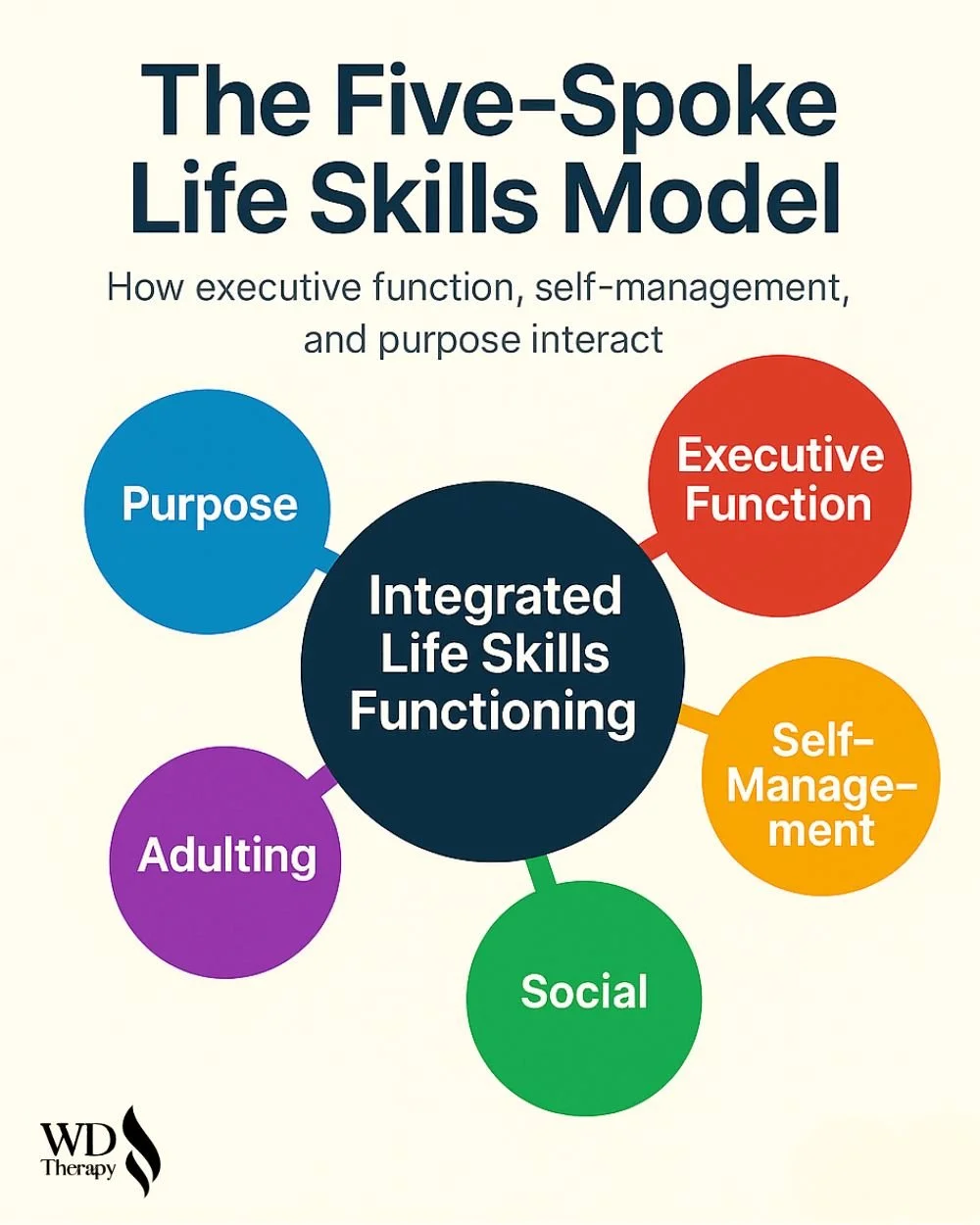
Do you ever feel like you fix one area of your life, only for another to collapse? This isn’t a personal flaw; it’s a systems issue. Your life isn’t a single problem to be solved but a complex system of interconnected parts.
Make it stand out
The Five-Spoke Life Skills Framework visualizes this system as a wheel. For the wheel to turn smoothly, each spoke must have sufficient strength. When one is weak, the whole wheel wobbles, making the ride exhausting. The five essential spokes are:
Executive Function Routines: The cognitive management systems that bridge the gap between intention and action.
Self-Management & Well-Being: The ability to regulate emotions, manage energy, and respond effectively to internal stressors.
Social & Communication Skills: Navigating relationships with clarity, authenticity, and the capacity for repair.
Practical Adulting Essentials: Managing the invisible infrastructure of daily life (finances, home, digital systems) that creates a stable foundation.
Purpose & Direction: Connecting daily actions to larger values and meaningful goals, which provides the fuel for sustained effort.
This model transforms the overwhelming monolith of “my life is a mess” into a workable diagram. It allows you to stop trying to fix everything at once and instead apply targeted, strategic action to the part of the system that needs the most support.
4. The Goal is Forward Motion
Every insight and action should be held up to a single governing question: How does this help me move forward?
Sometimes, moving forward requires going backward first, like reversing out of a driveway to drive forward on the street. Exploring the past can yield valuable insights, but even those harvests require cognitive clean-up. They must be organized and integrated in a way that serves your future.
This reframes being “stuck” not as a permanent state, but as a problem of overcoming inertia. We are often not just stuck, but frozen by indecision, doubt, and anxiety. The goal, then, is to generate just enough momentum to start rolling forward.
5. “Closing the Tabs” Is a Skill
In a culture that prizes productivity and multitasking, one of the most underrated skills is knowing when to collapse or converge. This is the necessary act of closing mental tabs to focus your finite resources on what is essential.
Many minds generate options faster than they can commit, which can create capacity issues. Creativity requires divergent thinking: opening tabs and exploring possibilities. But completion requires convergent thinking: making decisions and committing to a single path. Both are necessary. Learning to intentionally disengage is a direct and necessary strategy for managing the high “transaction fee” of daily life.
It is not giving up; it is strategic resource stewardship. Mastering the skill of closing tabs is a powerful antidote to burnout and a crucial component of a sustainable system for functioning in a demanding world.
The Problem as Part of a System
These five insights work together to shift your perspective from self-blame (”What’s wrong with me?”) to compassionate systems-thinking (”Which part of my system needs support?”). When you stop treating your life as a collection of problems and start seeing it as a system to be managed, the path forward becomes clearer.
Your life is not a problem to be fixed, but a system to be understood.
These five truths are tools to architect a life that works with your brain. They are the map that empowers you to move forward, not with brute force, but with compassion, strategy, and direction.|
Now that you have a map, which spoke of your wheel will you give your compassionate attention to first?
