

The Energy Economy of ADHD: Managing Daily Fluctuations & Metabolic Uncertainty
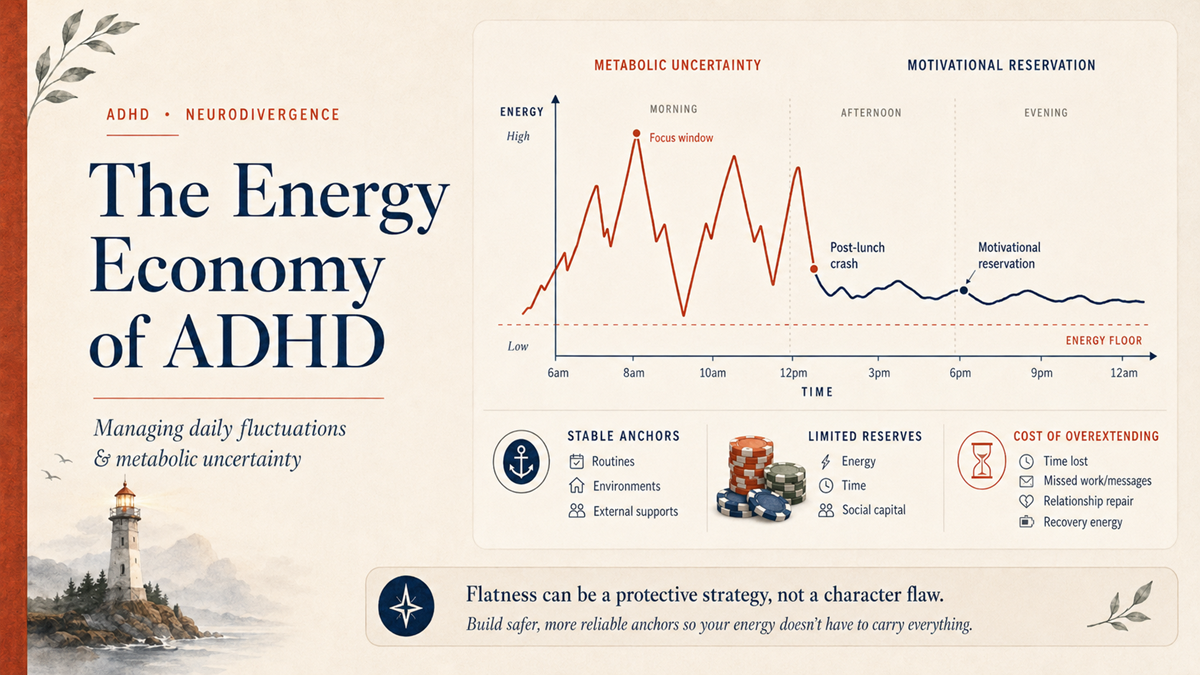
Do you ever feel hesitant to commit to a weekend plan, even if it's something you genuinely want to do? For adults with ADHD, this "flatness" or apathy isn't laziness—it's a learned, adaptive strategy to protect against unpredictable energy levels and catastrophic burnout.
But what if this isn't a lack of drive or passion? What if it is actually a deeply ingrained, logical survival strategy?
To understand this, it helps to look at the ADHD experience through a new lens: metabolic uncertainty.
The Search for Stable Anchors
One of the defining features of ADHD is inconsistency. Your ability to focus, initiate tasks, and sustain energy can fluctuate wildly depending on a bad night's sleep, minor stressors, or simply the time of day. For many, the only reliable pattern is that there is no pattern.
This fundamental lack of consistency creates a chronic, background hum of anxiety. Because our internal state is so unpredictable, neurodivergent individuals often become intense pattern-seekers in their external environments. We look for "anchors"—routines, specific environments, or external regulators—that can provide a reliable floor beneath the restless waves of our unpredictable energy.
The Predictability Problem
Think about managing a physical metric, like hydration or physical stamina. Usually, you can measure where you are, predict what you will need for an upcoming activity, and prepare accordingly (e.g., "I am going for a hike, so I will bring this amount of water and eat at this specific time.")
Cognitive and emotional energy in ADHD is rarely this measurable. You might use your typical management strategies—getting a good night's sleep, exercising, or utilizing behavioral tools—but their effects are rarely a guarantee. On Tuesday, a specific task might feel effortless; by Thursday, the exact same task might feel like moving mountains.
This makes it incredibly difficult to accurately predict your future capacity. You are operating in a chronic state of metabolic and energetic uncertainty.
"Motivational Reservation" and the Double Cost
This uncertainty fundamentally changes how we make plans and generate motivation.
Motivation is essentially an energetic current. When you have a definite plan and you know you will have the energy to execute it, that current flows freely. But when your future energy is a question mark, your brain hesitates.
Generating motivation is biologically and energetically costly. If you muster up the excitement and energy to do something, but then your executive function fails or you crash, you experience a double cost. Not only did you spend precious energy getting motivated, but you also now have to spend recovery energy to bounce back from the disappointment and physiological deflation of a failed plan.
To avoid this, many adults with ADHD adopt a subconscious stance of motivational reservation. We hedge our bets. We keep our upfront excitement contained because we can't guarantee we'll have the resources to follow through.
Playing Poker with a Short Stack
As we age and take on the complex responsibilities of adulthood—careers, families, relationships—the stakes get higher. The energetic buffers we might have had in our youth slowly disappear.
Living with unpredictable ADHD energy is like playing a game of poker with a very small stack of chips. You have to play cautiously. If you bet big (over-extending yourself socially or professionally) and lose, you don't just lose the chips on the table. You lose time, energy, and social capital.
When you overdo it, you face an agonizing biological imperative: burnout recovery. You can't mask it, you can't fake it, and you can't push through it. Your battery is dead. And while you spend a day or two recharging, the world keeps moving. You miss work messages, you delay responding to friends, and you accrue a "downstream debt." When you finally have energy again, you have to spend it apologizing, catching up, and doing relational repair.
Redefining the "Flat" Feeling
When the cost of betting and losing is so high, the most logical strategy is to play it painfully safe. You avoid making big waves. You hold back.
It is no wonder, then, that so many adults with ADHD report feeling apathetic, flat, or directionless. This isn't a character flaw; it is an intelligent, adaptive response to a nervous system that struggles to predict its own future state. You are simply trying to protect your remaining chips.
Start with the next useful step.
If this frame resonates, the next step may be getting a clearer picture of the system you are actually working with.
References
Cohen, M., & Atzil, S. (2026). A metabolic framework for reward: Redefining dopamine and opioids as physiological agents. Neuroscience and Biobehavioral Reviews, 184, Article 106608. https://doi.org/10.1016/j.neubiorev.2026.106608
