

The Recursive Mind: Feeding Back to Feedforward

Many people think carefully about their lives, care deeply about their responsibilities, and yet watch days slip by without acting on their intentions. From the outside they seem capable; inside, they struggle with what feels like it should be so simple: starting.
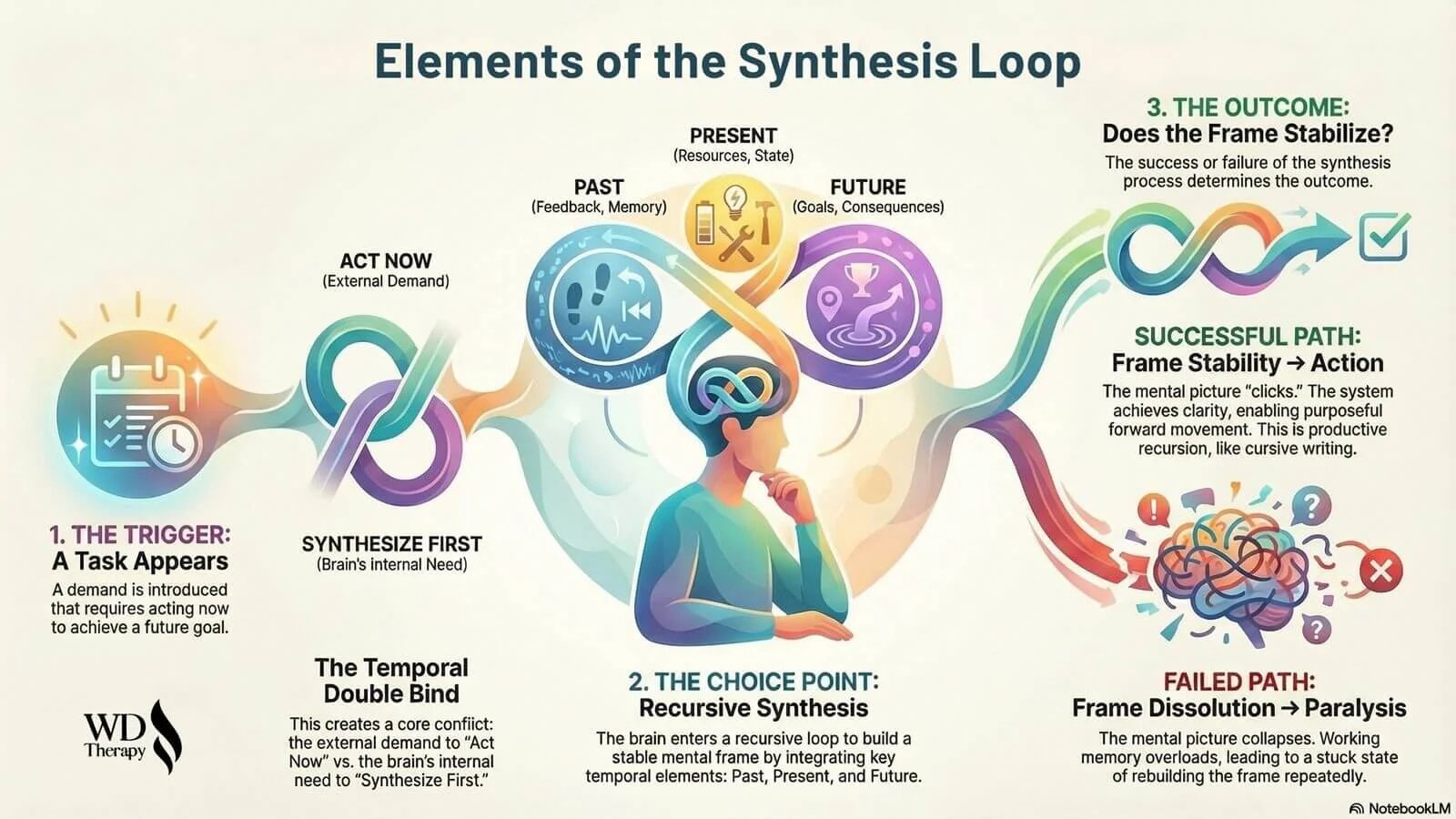
RTAL names what happens in the space between intention and action. This is the inner return where timing, readiness, and consequence are reappraised before the mind permits action. Some minds continuously appraise these factors, feeding each evaluation back into the decision process. The Recursive Temporal Appraisal Loop (RTAL) describes this feedback-first system.
Core Idea
RTAL starts from a simple observation: for some people, the mind does not move in a straight line from intention to action. It loops. Each time you consider starting, you also re-check whether this is the right moment, whether you are ready, and what might happen if you begin now instead of later. Each new appraisal is fed back into the system as another input, so the decision does not simply progress forward; it recirculates. In that sense, the act of moving forward immediately reminds you of where you are in time, which can trigger another round of questions about timing, readiness, and adequacy.
A central claim of RTAL is that some minds are structurally inclined to loop before they move. The same back-and-forth that helps you think deeply about relationships, projects, or long-term plans also appears in everyday choices: rewinding to check, rehearsing how something might go, scanning for what you might have missed. Minor and major actions pass through this same internal machinery.
Before sending an email, starting a task, or committing to a plan, the mind quietly asks: Have I considered everything? Is the future cost acceptable? Do I have what I need internally to begin?
This architecture is context-dependent. A recursive mind can support thoroughness, conscientiousness, and exceptional planning. It often notices patterns others miss and anticipates downstream consequences that matter. But when that same architecture is paired with limited working memory, fluctuating energy, or chronic self-doubt, it can generate a very different lived experience: a mind that loops before it moves, and sometimes loops so extensively that moving at all becomes difficult.
Time as a Loop, Not a Line
RTAL focuses on how these loops unfold in time. We often imagine goal pursuit as a straightforward path: you start at point A, walk through a sequence of steps, and eventually arrive at point B. Time is pictured as a straight arrow that points toward a destination. Inside a recursive mind, the path rarely feels that clean or certain. Turning back, whether literally on a road trip or metaphorically in reopening a decision you believed was settled, can provoke tension and frustration.
It carries a double cost: the sense that past time has been wasted and the expectation that future time will now be delayed.
For people whose minds habitually loop, these reversals are not occasional detours but recurring patterns. The same internal system that checks, revises, and replays decisions in the name of accuracy also amplifies frustration and guilt.
You are not only delayed by external obstacles; you feel held up by your own thinking.
You may recognize that your caution comes from a genuine desire to be responsible, yet the pull to return and review once more, or to analyze future possibilities “just one last time,” disrupts your plan to move forward. Over time, this can create a persistent sense of friction or being at odds with yourself.
Before acting, the mind repeatedly appraises where you are in time, what the task will demand, how it intersects with other obligations, and what risks are attached to starting now versus waiting.
If none of these appraisals produces a “good enough” response, the system does not settle. It continues to iterate and loops back on itself.
In RTAL terms, the loop fails to reach a base case: a stopping point that grants permission to move forward. The result is a felt sense of being stuck even when you genuinely want the goal, know the steps, and intend to follow through. You can name the task, explain why it matters, and still experience internal friction when simply trying to begin.
The Lived Experience
At the phenomenological level (i.e., lived experience), RTAL addresses a common question among neurodivergent people:
How can I constantly be thinking about something and still struggle to start? How can I feel as though I am working all the time internally, rehearsing conversations, replaying decisions, and mentally walking through steps, while externally very little seems to change?
RTAL treats initiation as the outcome of a recursive process that must settle into a workable configuration before action becomes possible.
When that configuration never stabilizes, the person is left with a growing history of incomplete starts and “do it again” cycles. Each attempt to begin becomes part of the next appraisal: I have tried this before, so what makes this time different? Over time, the loop is not only about the task but also about one’s own track record. The system begins to appraise not just “Is this the right time?” but “Am I the kind of person who can actually do this?”, adding another layer of weight to each decision point.
The Framework
RTAL reframes the difficulty of beginning. For many recursive minds, the first impulse toward a task initiates a return to the starting point. The system loops to evaluate timing, risk, and readiness before authorizing forward movement.
This reversal carries a double cost: the backward step feels like regression, and the resulting delay feels like lost potential. When internal noise, such as anxiety or cognitive clutter, exceeds the system’s capacity, the loop cannot complete its synthesis. What emerges is rumination without resolution.
The core principle is this: synthesis precedes action. Recognizing this reframes hesitation as an architectural necessity rather than a moral failing.
In future posts, I will explore how this framework connects to executive function, metacognition, and time perception in ADHD and related neurodivergent profiles.
Read the full preprint:
Waller-DeLaRosa, S. A. (2025, November 7). The Recursive Temporal Appraisal Loop (RTAL): A Feedback-First Architecture Model of ADHD. https://doi.org/10.31234/osf.io/gpbyx_v1
